【考点】O2:故事类阅读
【分析】本文是一位从小就被母亲送走的母亲写给女儿的一封情真意切的信,信里充满了对女儿的爱以及对自己之前的生活的回想,对自己的母亲的怀念之情
【解答】65.D 细节题.根据第一段中"You are more than just a second child,more thanjust a girl to match our boy.You,little daughter,are the link to our female line"可知这一天她的女儿出生了.更重要的是家族里的女性传承得以延续.故选 D
66.B 推理题.根据第二段最后 3 行 Worn down by the demands of the new baby and perhaps the constant threat of starvation,she made the painful decision to give away her girl so that both of us might have a chance for a better life.可知她的母亲把她送走也是万般无奈,要不 然两个人没有好的生活.所以她对母亲的选择是可以接受和理解的,但是同时被母亲送 走的确是一件很痛苦的事情.故选B
67.D 推理题.根据段"In a family of blue﹣eyed blonds,though,I stood out like a sore thumb".家里都是蓝眼睛的白种人,而我是一个黄皮肤黑头发的中国人.Though后面这 句话说明我和他们是不一样的.故选D
68.A 推理题.根据第四段中的"Whether from jealousy or fear of someone who looked so different,my older brothers sometimes teased me about my unpleasing skin,or made fun of my clumsy walk."可知在这个家庭里不知道是处于嫉妒还是恐惧我的哥哥们有时会嘲笑 我.再根据"My mother and I conflicted countless times over the years,but gradually came to see one another as real human beings with faults and talents,and as women of strength in our own right"可知我和妈妈经常发生冲突.这些事情让我感觉自己的生活没有安全感,总是 很惶恐,缺乏安全感.进而产生了身份危机.故选A
69 . C 推 理 题 . 根 据 文 章 倒 数 第 二 段 That , plus a little knowledge of classroomCantonese,is all the Chinese culture I have to offer you.Not white,certainly,but not reallyAsian,I try to pave the way between the two worlds and bridge the gap for you.Your name,"Shao﹣ming,"is very much like mine﹣"Shao"means"little."And"ming"is"bright"可知母亲想给女儿添加一些中国文化的元素,所以女儿的名字为Shao ming,让女儿知道自己的祖先有中国血统.故选C
【答案】B
【解析】推理题.根据下一句"and each day I cradle you in your babyhood,generously giving you the loving care I lacked for my first two years."得知母亲一直在照顾着女儿,这和母亲 自己的经历是不同的.母亲很小就被送走了,没有享受到母爱.所以该句是指 B 项含 义.故选B
【点评】文章是社会生活类阅读,要求学生仔细阅读文章,理解文章大意,找到相关信息回答问题,以及推断答案
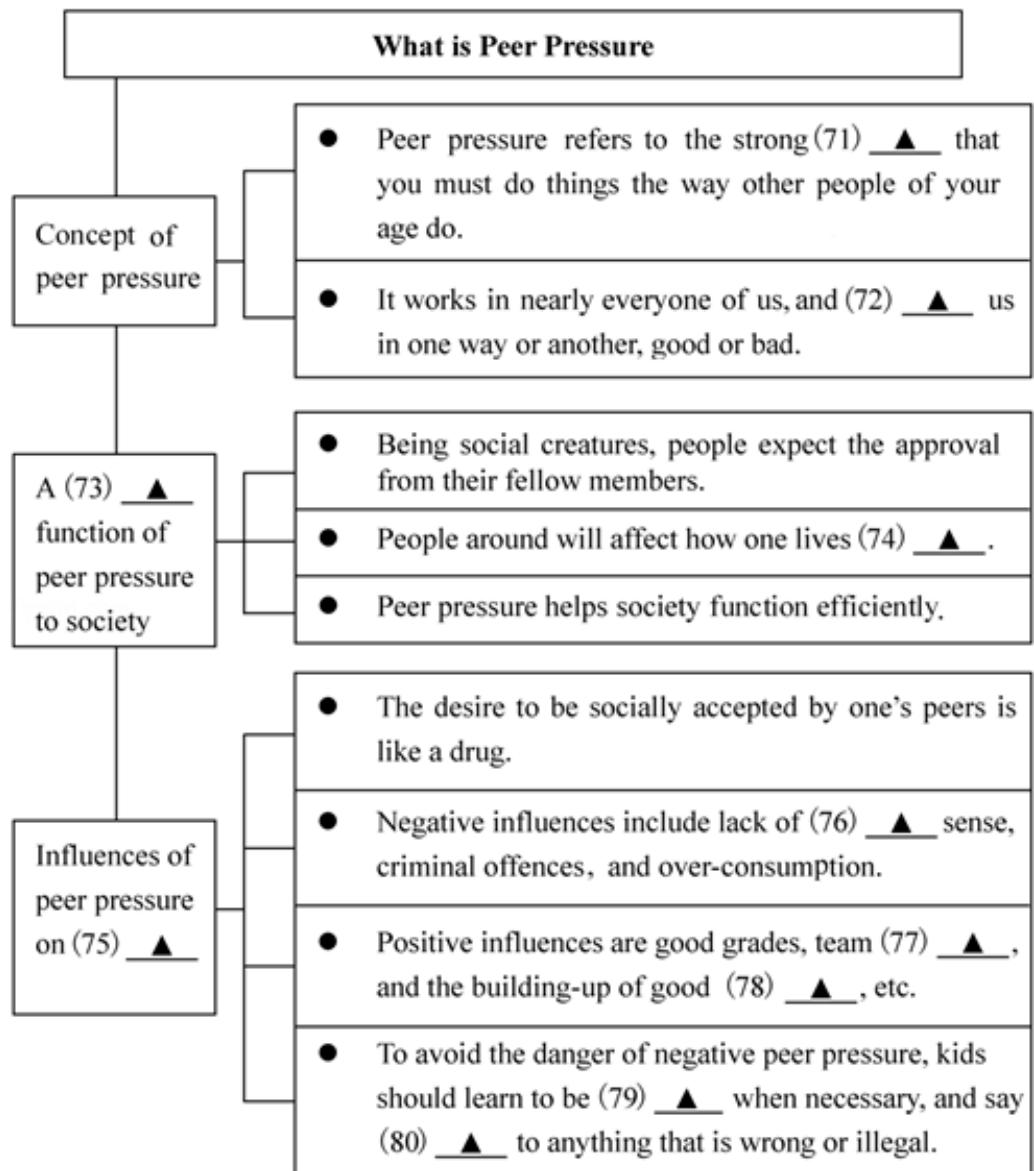
第四部分:任务型阅读(共 1 小题;每小题 10 分,满分 10 分)请阅读下面短文,并根据所读内容在文章后表格中的空格里填入一个最恰当的单词.注意:请将答案写在答题卡上相应题号的横线上.每个空格只填一个单词
31.(10 分)The expression,"everybody's doing it,"is very much at the center of the concept of peer pressure.It is a strong influence of a group,especially of children,on members of that group to behave as everybody else does.It can be positive or negative.Most people experience it in some way during their lives
People are social creatures by nature , and so it is hardly surprising that part of their self﹣ respect comes from the approval of others.This instinct (天性) is why the approval of peers,or the fear of disapproval,is such a powerful force in many people's lives.It is the same instinct that drives people to dress one way at home and another way at work , or to answer"fine"when a stranger asks"how are you?"even if it is not necessarily true.There is a practical aspect to this:it helps society to function efficiently,and encourages a general level of self﹣discipline that simplifies day﹣to﹣day interaction
For certain individuals , seeking social acceptance is so important that it becomes like an addiction; in order to satisfy the desire,they may go so far as to abandon their sense of right and wrong.Teens and young adults may feel forced to use drugs,or join gangs that encourage criminal behavior.Mature adults may sometimes feel pressured to cover up illegal activity at the company where they work,or end up in debt because they are unable to hold back the desire to buy a house or car that they can't afford in an effort to"keep up with the Joneses."
However,peer pressure is not always negative.A student whose friends are good at academics may be urged to study harder and get good grades.Players on a sports team may feel driven to play harder in order to help the team win . This type of influence can also get a friend off drugs,or to help an adult take up a good habit or drop a bad one.Study groups and class projects are examples of positive peer groups that encourage people to better themselves
Schools try to teach kids about the dangers of negative peer pressure.They teach kids to stand up and be themselves,and encourage them to politely decline to do things that they believe are wrong.Similarly,it can be helpful to encourage children to greet the beneficial influence of positive peer groups