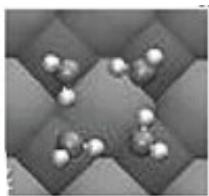
(2分)水是生命之源,2014年我国科学家首次拍摄到水分子团簇的空间取向图象,模型如图所示,下列关于水的说法正确的是( )
Answer key
A
Did you get it?
在线查看并练习本卷。答案默认隐藏,完成练习后可生成薄弱考点、失分原因和针对性练习建议。
GaokaoHub 高考真题检索 · 在线做题与完整解析:https://gaokaohub.com/paper/2014-jiangsu-chemistry-16610.html
Just answer directly. If you get stuck, tap "Give me a hint" or "Help me understand". A wrong answer won't instantly reveal the solution.
(2分)水是生命之源,2014年我国科学家首次拍摄到水分子团簇的空间取向图象,模型如图所示,下列关于水的说法正确的是( )
A
(2 分) $2 5 \mathrm { { ^ \circ C } }$ 时,下列各组离子在指定溶液中一定能大量共存的是( )A $\mathsf { p H } { = } 1$ 的溶液中: $\mathrm { N a ^ { + } , \ K ^ { + } , \ M n O _ { 4 } \bar { \Omega } , \ C O _ { 3 } { } ^ { 2 } }$ B. $\textbf { c } ( \mathrm { H } ^ { + } ) \ : = \ : 1 \times 1 0 ^ { - 1 3 } \mathrm { m o l } { \cdot } \mathrm { L }$ <sup>﹣1</sup> 的溶液中: $\mathrm { M g ^ { 2 + } , \ C u ^ { 2 + } , \ S O _ { 4 } ^ { 2 - } , \ N O _ { 3 } }$ C. $0 . 1 { \bmod { \cdot } } \mathrm { L } ^ { - 1 } \mathrm { N } \mathrm { H } _ { 4 } \mathrm { H } \mathrm { C O } _ { 3 }$ 溶液中: $\mathrm { K } ^ { + } , \ N a ^ { + } , \ N O _ { 3 } ^ { - }$ 、Cl<sup>﹣</sup>D $0 . 1 \mathrm { m o l } { \cdot } \mathrm { L } ^ { - 1 } \mathrm { F e C l } _ { 3 }$ 溶液中: $\mathrm { F e ^ { 2 + } , \ N H _ { 4 } ^ { + } , \ S C N ^ { - } , \ S O _ { 4 } { } ^ { 2 } }$
C
(2分)下列物质性质与应用对应关系正确的是( )
B
(2分)下列装置应用于实验室制氯气并回收氯化锰的实验,能达到实验目的是( )
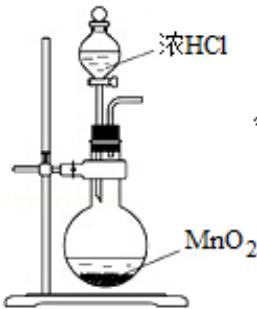
甲
乙
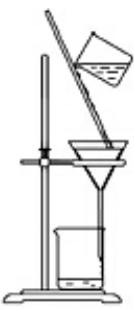
丙
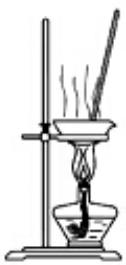
丁
C
(2分)设 $\mathrm { N _ { A } }$ 为阿伏伽德罗常数的值,下列说法正确的是( )
A
(2 分)下列指定反应的离子方程式正确的是( )
D
(2分)下列各组物质中,不满足组内任意两种物质在一定条件下均能发生反应的是( )
<table><tr><td rowspan=1 colspan=1>物质组别</td><td rowspan=1 colspan=1>甲</td><td rowspan=1 colspan=1>乙</td><td rowspan=1 colspan=1>丙</td></tr><tr><td rowspan=1 colspan=1>A</td><td rowspan=1 colspan=1> ${ \bf A l } _ { 2 } { \bf O } _ { 3 }$ </td><td rowspan=1 colspan=1>HCl</td><td rowspan=1 colspan=1>NaOH</td></tr><tr><td rowspan=1 colspan=1>B</td><td rowspan=1 colspan=1> $\mathrm { S i O } _ { 2 }$ </td><td rowspan=1 colspan=1>NaOH</td><td rowspan=1 colspan=1>HF</td></tr><tr><td rowspan=1 colspan=1>C</td><td rowspan=1 colspan=1>HCl</td><td rowspan=1 colspan=1>NaOH</td><td rowspan=1 colspan=1> ${ \mathrm { N a H C O } } _ { 3 }$ </td></tr><tr><td rowspan=1 colspan=1>D</td><td rowspan=1 colspan=1> $\mathrm { N H } _ { 3 }$ </td><td rowspan=1 colspan=1> ${ \bf O } _ { 2 }$ </td><td rowspan=1 colspan=1> $\mathrm { H N O } _ { 3 }$ </td></tr></table>
D
(2 分)短周期主族元素 X、Y、Z、W 的原子序数依次增大.X 原子的最外层电子数是其内层电子数的2倍,Y 是地壳中含量最高的元素, $Z ^ { 2 + }$ 与 ${ \mathrm { Y } } ^ { 2 \cdot }$ 具有相同的电子层结构,W与X 同主族.下列说法正确的是( )
C
(2分)已知: C $\left( \mathbf { s } \right) + \mathbf { O } _ { 2 } \left( \mathbf { g } \right) = \mathrm { C O } _ { 2 } \left( \mathbf { g } \right) \ \triangle \mathrm { H } _ { 1 }$ $\mathrm { C O } _ { 2 } \mathrm { ( } \mathrm { { \bf g } ) } + \mathrm { C } \mathrm { ( } \mathrm { { \bf s } ) } - 2 \mathrm { C O } \mathrm { ( } \mathrm { { \bf g } ) } \triangle \mathrm { H } _ { 2 }$ $2 \mathrm { C O } \mathrm { ( } \mathbf { g ) } + \mathrm { O } _ { 2 } \mathrm { ( } \mathbf { g ) } = 2 \mathrm { C O } _ { 2 } \mathrm { ( } \mathbf { g ) } \ \triangle \mathrm { H } _ { 3 }$ 4Fe $\mathrm { ( \mathbf { s } ) \ + 3 O _ { 2 } \Delta \mathrm { ( \mathbf { g } ) = 2 F e _ { 2 } O _ { 3 } \Delta \mathrm { ( \mathbf { s } ) \ \triangle \mathrm { H } _ { 4 } } } }$ 3CO $\mathrm { ( \mathbf { g } ) \ + F e _ { 2 } O _ { 3 } \Delta \left( \mathbf { s } \right) = 3 C O _ { 2 } \Delta \left( \mathbf { g } \right) \ + 2 F e \Delta \left( \mathbf { s } \right) \ \triangle \mathrm { H } _ { 5 } }$
下列关于上述反应焓变的判断正确的是(A $\triangle \mathrm { H } _ { 1 } { > } 0 , \triangle \mathrm { H } _ { 3 } { < } 0$ B $\Delta \mathrm { H } _ { 2 } { > } 0 , \Delta \mathrm { H } _ { 4 } { > } 0$ C $\triangle \mathrm { H } _ { 1 } { = } \triangle \mathrm { H } _ { 2 } { + } \triangle \mathrm { H } _ { 3 }$ D $\triangle \mathrm { H } _ { 3 } { = } \triangle \mathrm { H } _ { 4 } { + } \triangle \mathrm { H } _ { 5 }$
C
(4分)下列有关说法正确的是( )A.若在海轮外壳上附着一些铜块,则可以减缓海轮外壳的腐蚀B $\ 2 \mathrm { N O } \ \mathrm { ( } \mathrm { \bf ~ g ) } \ + 2 \mathrm { C O } \ \mathrm { ( } \mathrm { \bf ~ g ) } \ = \mathrm { N } _ { 2 } \ \mathrm { ( } \mathrm { \bf ~ g ) } \ + 2 \mathrm { C O } _ { 2 }$ (g)在常温下能自发进行,则该反应的 $\triangle \mathrm { H } >$
0C.加热 $\mathrm { 0 . 1 m o l ^ { \bullet } L ^ { - 1 } N a _ { 2 } C O _ { 3 } }$ 溶液, $\mathrm { C O } _ { 3 } { } ^ { 2 }$ <sup>﹣</sup>的水解程度和溶液的 $\mathsf { p H }$ 均增大D.对于乙酸与乙醇的酯化反应 $( \triangle \mathrm { H } { < } 0 )$ ),加入少量浓硫酸并加热,该反应的反应速率
和平衡常数均增大
C
(4 分)去甲肾上腺素可以调控动物机体的植物性神经功能,其结构简式如图所示。下
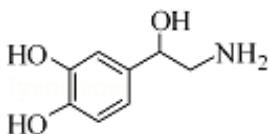
列说法正确的是( )
D
(4 分)在探究新制饱和氯水成分的实验中,下列根据实验现象得出的结论不正确的是( )
D
(4分)一定温度下,在三个体积均为1.0L的恒容密闭容器中发生反应: $2 \mathrm { C H } _ { 3 } \mathrm { O H } ~ ( \mathbf { g } )$ $ C H _ { 3 } O C H _ { 3 } ( \mathbf { g } ) + H _ { 2 } O ( \mathbf { g } )$
<table><tr><td rowspan=2 colspan=1>容器编号</td><td rowspan=2 colspan=1>温度(℃)</td><td rowspan=1 colspan=1>起始物质的量(mol)</td><td rowspan=1 colspan=2>平衡物质的量(mol)</td></tr><tr><td rowspan=1 colspan=1> $\mathrm { C H } _ { 3 } \mathrm { O H } \ ( \mathbf { g } )$ </td><td rowspan=1 colspan=1> $\mathrm { C H } _ { 3 } \mathrm { O C H } _ { 3 } \ \mathrm { ( } \mathbf { g ) }$ </td><td rowspan=1 colspan=1> $\mathrm { H } _ { 2 } \mathrm { O }$ </td></tr><tr><td rowspan=1 colspan=1>I</td><td rowspan=1 colspan=1>387</td><td rowspan=1 colspan=1>0.20</td><td rowspan=1 colspan=1>0.080</td><td rowspan=1 colspan=1>0.080</td></tr><tr><td rowspan=1 colspan=1>ⅡI</td><td rowspan=1 colspan=1>387</td><td rowspan=1 colspan=1>0.40</td><td rowspan=1 colspan=1></td><td rowspan=1 colspan=1></td></tr><tr><td rowspan=1 colspan=1>ⅢII</td><td rowspan=1 colspan=1>207</td><td rowspan=1 colspan=1>0.20</td><td rowspan=1 colspan=1>0.090</td><td rowspan=1 colspan=1>0.090</td></tr></table>
下列说法正确的是( )
AD
(15 分)实验室从含碘废液(除 $\mathrm { H } _ { 2 } \mathrm { O }$ 外,含有 $\begin{array} { r l } { \mathrm { C C l } _ { 4 } \mathrm { , } } & { { } \mathrm { I } _ { 2 } \mathrm { , } } \end{array} \mathrm { I } ^ { - \frac { \hbar ^ { * } / 5 } { \tau } } \big )$ 中回收碘,其实验过程如图一所示
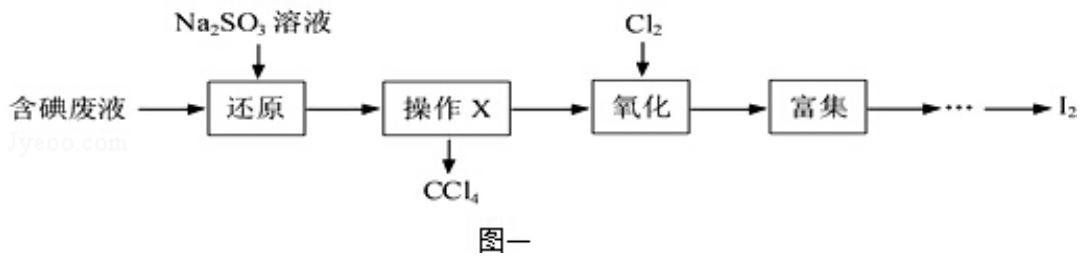
(1)向含碘废液中加入稍过量的 ${ \mathrm { N a } } _ { 2 } { \mathrm { S O } } _ { 3 }$ 溶液,将废液中的 $\mathrm { I } _ { 2 }$ 还原为I<sup>﹣</sup>,其离子方程式为 $\mathrm { S O _ { 3 } } ^ { 2 \cdot - } + \mathrm { I } _ { 2 } \mathrm { + H _ { 2 } O } = 2 \mathrm { I } ^ { \cdot } + 2 \mathrm { H } ^ { + } \mathrm { + S O _ { 4 } } \underline { { { 2 \cdot } } }$ ;该操作将 $\mathrm { I } _ { 2 }$ 还原为I<sup>﹣</sup>的目的是 使四氯化碳中的碘进入水层
(2)操作X 的名称为 分液
(3)氧化时,在三颈烧瓶中将含 I<sup>﹣</sup>的水溶液用盐酸调至 pH 约为 2,缓慢通入 $\mathrm { C l } _ { 2 }$ ,在$4 0 \mathrm { { ^ \circ C } }$ 左右反应(实验装置如图二所示).实验室控制在较低温度下进行的原因是 使氯气在溶液中有较大的溶解度(或防止碘升华或防止碘进一步被氧化) ;锥形瓶里盛放的溶液为 NaOH溶液
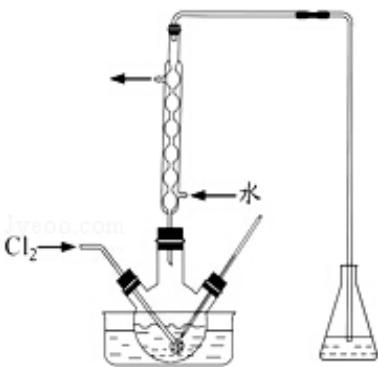
图二
(4)已知: $5 \mathrm { S O _ { 3 } } ^ { 2 \cdot } + 2 \mathrm { I O _ { 3 } } ^ { \cdot } + 2 \mathrm { H } ^ { + } - \mathrm { I } _ { 2 } + 5 \mathrm { S O _ { 4 } } ^ { 2 \cdot } + \mathrm { H } _ { 2 } \mathrm { O }$
某含碘废水 $\mathrm { ( \mathfrak { p H } }$ 约为8)中一定存在 $\mathrm { I } _ { 2 } ,$ ,可能存在I<sup>﹣</sup>、 $\mathrm { I O } _ { 3 }$ <sup>﹣</sup>中的一种或两种,请补充完整检验含碘废水中是否含有I<sup>﹣</sup>、 $\mathrm { I O } _ { 3 }$ <sup>﹣</sup>的实验方案:取适量含碘废水用 $\mathrm { C C l } _ { 4 }$ 多次萃取、分液,直到水层用淀粉溶液检验不出有碘单质存在 从水层取少量溶液,加 $\Delta 1 - 2 \mathrm { m L }$ 淀粉溶液,加入盐酸酸化,滴加 $\underline { { \mathrm { F e C l } _ { 3 } } }$ 溶液,若溶液变蓝色,说明废水中含有 I<sup>﹣</sup>,否则不含 I<sup>﹣</sup>;
另从水层取少量溶液,加入 $1 - 2 \mathrm { m L }$ 淀粉试液,加盐酸酸化,滴加 ${ \underline { { \mathrm { N a } } } } _ { 2 } { \underline { { \mathrm { S O } } } } _ { 3 }$ 溶液,若溶液变蓝色,说明废水中含有 $\underline { { \mathrm { I O } _ { 3 _ { - } } } }$ <sup>﹣</sup>,否则不含 $\underline { { \mathrm { I O } } } _ { 3 } .$ <sup>﹣</sup> .实验中可供选择的试剂:稀盐酸、淀粉溶液、 $\mathrm { F e C l } _ { 3 }$ 溶液、 ${ \mathrm { N a } } _ { 2 } { \mathrm { S O } } _ { 3 }$ 溶液.
(1) SO32﹣+I2+H2O=2I﹣+2H++SO42﹣; (2) 分液; (3) 使氯气在溶液中有较大的溶解度(或防止碘升华或防止碘进一步被氧化); (4) 从水层取少量溶液,加入 1﹣2mL 淀粉溶液,加入盐酸酸化,滴加 FeCl3 溶液,若溶液变蓝色,说明废水中含有 I﹣,否则不含 I﹣; 另从水层取少量溶液,加入 1﹣2mL 淀粉试液,加盐酸酸化,滴加 Na2SO3 溶液,若溶液变蓝色,说明废水中含有 IO3﹣,否则不含 IO3﹣
中档题为主
单选 10 · 解答 3 · 多选 1
中档 14
Start from one question and continue with the same question type, knowledge point, and approach. You can also describe this paper's topics in one sentence to build a practice paper or handout and print it.
Back to main search to view this paper