如图示是α粒了(氦原子核)被重金属原子核散射的运动轨迹,M、N、P、Q是轨迹上的四点,在散射过程中可以认为重金属原子核静止不动.图中所标出的α粒子在各点处的加速度方向正确的是( )
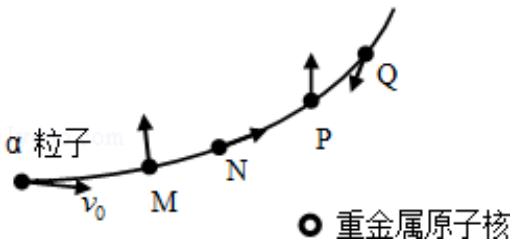
0 重金属原子核
在线查看并练习本卷。答案默认隐藏,完成练习后可生成薄弱考点、失分原因和针对性练习建议。
GaokaoHub 高考真题检索 · 在线做题与完整解析:https://gaokaohub.com/paper/2015-province-legacy-physics-24225.html
5 道真题
Just answer directly. If you get stuck, tap "Give me a hint" or "Help me understand". A wrong answer won't instantly reveal the solution.
如图示是α粒了(氦原子核)被重金属原子核散射的运动轨迹,M、N、P、Q是轨迹上的四点,在散射过程中可以认为重金属原子核静止不动.图中所标出的α粒子在各点处的加速度方向正确的是( )
0 重金属原子核
由库仑定律可知,真空中两个静止的点电荷,带电量分别为 $\displaystyle { \lvert { \bf q } _ { 1 } }$ 和 $\lvert \mathbf { q } _ { 2 }$ ,其间距离为r时,它们之
间相互作用力的大小为 $\mathrm { F = k } \frac { \mathrm { ~ } \mathbb { q } _ { 1 } \mathrm { ~ } \mathbb { q } _ { 2 } } { \mathrm { ~ } \mathrm { r } ^ { 2 } } ,$ ,式中k为静电力常量.若用国际单位制的基本单位表示,k的
单位应为( )A $\mathrm { k g } \bullet \mathrm { A } ^ { 2 } \bullet \mathrm { m } ^ { 3 }$ B $\mathrm { k g } { \bullet \mathrm { A } } ^ { - 2 } { \bullet \mathrm { m } } ^ { 3 } { \bullet \mathrm { s } } ^ { - 4 }$ C D$\mathrm { k g } \bullet \mathrm { m } ^ { 2 } \bullet \mathrm { C } ^ { - 2 }$ $\mathrm { N } { \bullet \mathrm { m } ^ { 2 } { \bullet \mathrm { A } ^ { - 2 } } }$
分析: 力学单位制规定了物理量的单位,同时根据物理量间的公式也可以分析单位之间的关系
一根长为L、横截面积为S的金属棒,其材料的电阻率为ρ,棒内单位体积自由电子数为n,电子的质量为m,电荷量为e,在棒两端加上恒定的电压时,棒内产生电流,自由电子定向运动的平均速率为v,则金属棒内的电场强度大小为( )
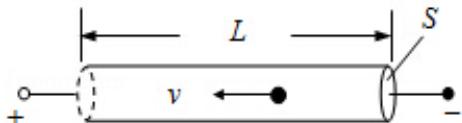
A $\frac { \mathfrak { m } \mathfrak { v } ^ { 2 } } { 2 \mathfrak { e } \mathrm { L } }$ B $\frac { \mathtt { m v } ^ { 2 } \mathtt { S n } } { \mathtt { e } }$ C $\mathsf { p n e v }$ D $\frac { \rho _ { \tt e v } } { \mathrm { S L } }$
某同学为了测量一节电池的电动势和内阻,从实验室找到以下器材:一个满偏电流为100μA、内阻为2500Ω的表头,一个开关,两个电阻箱(0~999.9Ω)和若干导线
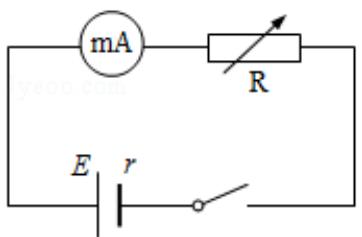
图1
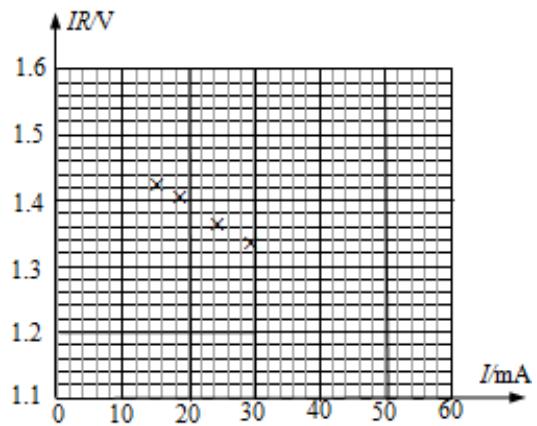
图2
(1)由于表头量程偏小,该同学首先需将表头改装成量程为50mA的电流表,则应将表头与电阻箱 并联 (填“串联”或“并联”),并将该电阻箱阻值调为 5.0 Ω
(2)接着该同学用改装的电流表对电池的电动势及内阻进行测量,实验电路如图1所示,通过改变电阻R测相应的电流I,且作相关计算后一并记录如表:
<table><tr><td rowspan=1 colspan=1></td><td rowspan=1 colspan=1>1</td><td rowspan=1 colspan=1>2</td><td rowspan=1 colspan=1>3</td><td rowspan=1 colspan=1>4</td><td rowspan=1 colspan=1>5</td><td rowspan=1 colspan=1>6</td></tr><tr><td rowspan=1 colspan=1>R(Ω)</td><td rowspan=1 colspan=1>95.0</td><td rowspan=1 colspan=1>75.0</td><td rowspan=1 colspan=1>55.0</td><td rowspan=1 colspan=1>45.0</td><td rowspan=1 colspan=1>35.0</td><td rowspan=1 colspan=1>25.0</td></tr><tr><td rowspan=1 colspan=1>I(mA)</td><td rowspan=1 colspan=1>15.0</td><td rowspan=1 colspan=1>18.7</td><td rowspan=1 colspan=1>24.8</td><td rowspan=1 colspan=1>29.5</td><td rowspan=1 colspan=1>36.0</td><td rowspan=1 colspan=1>48.0</td></tr><tr><td rowspan=1 colspan=1>IR(V)</td><td rowspan=1 colspan=1>1.42</td><td rowspan=1 colspan=1>1.40</td><td rowspan=1 colspan=1>1.36</td><td rowspan=1 colspan=1>1.33</td><td rowspan=1 colspan=1>1.26</td><td rowspan=1 colspan=1>1.20</td></tr></table>
①根据表中数据,图2中已描绘出四个点,请将第5、6两组数据也描绘在图2中,并画出IR﹣I图线;
②根据图线可得电池的电动势E是 1.53 V,内阻r是 2.0 Ω
分析: ①由电表的改装原理可明确应并联一个小电阻分流来扩大电流表量程,根据并联电路规律可求得对应的电阻;
> ②由描点法得出图象;再由闭合电路欧姆定律求出表达式,由图象即可求出电动势和内电阻
一质量为0.5kg的小物块放在水平地面上的A点,距离A点5m的位置B处是一面墙,如图所示,物块以 $\mathrm { { v } } _ { 0 } { = } 9 \mathrm { { m } } / \mathrm { { s } }$ 的初速度从A点沿AB方向运动,在与墙壁碰撞前瞬间的速度为7m/s,碰后以6m/s的速度反向运动直至静止.g取 $\mathrm { 1 0 m } / \mathrm { s } ^ { 2 }$
(1)求物块与地面间的动摩擦因数μ;
(2)若碰撞时间为0.05s,求碰撞过程中墙面对物块平均作用力的大小F;
(3)求物块在反向运动过程中克服摩擦力所做的功W
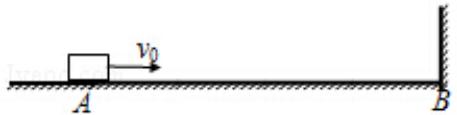
(1)对物块应用动能定理可以求出动摩擦因数
(2)对物块应用动量定理可以求出作用力大小
(3)应用动能定理可以求出物块反向运动过程克服摩擦力做的功
Start from one question and continue with the same question type, knowledge point, and approach. You can also describe this paper's topics in one sentence to build a practice paper or handout and print it.
Back to main search to view this paper