10.(12 分)近年来,研究人员提出利用含硫物质热化学循环实现太阳能的转化与存储,过程如下:
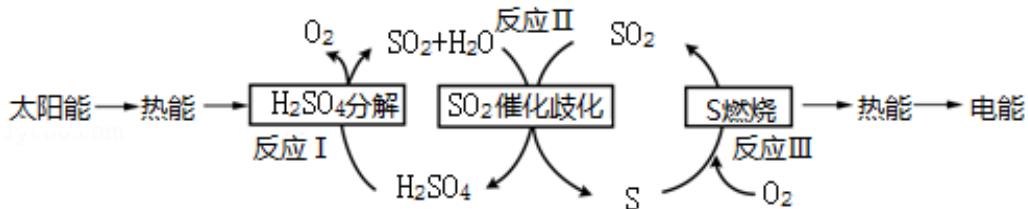
(1)反应Ⅰ: $\mathrm { 2 H _ { 2 } S O _ { 4 } \left( 1 \right) \ = 2 S O _ { 2 } \left( g \right) \ + 2 H _ { 2 } O \left( g \right) \ + O _ { 2 } \left( g \right) \ + \triangle H _ { 1 } = + 5 5 1 k J * m o l \Phi ^ { - 1 } }$ 反应Ⅲ:S $\mathrm { ( \bf ~ s ) ~ + O _ { 2 } ~ ( \bf ~ g ) } = { \bf S O } _ { 2 } \mathrm { ~ ( \bf ~ g ) ~ } \triangle \mathrm { H } _ { 3 } = - 2 9 7 \mathrm { ~ k J } \bullet \mathrm { m o l } ^ { - 1 }$
反应Ⅱ的热化学方程式: $3 \mathrm { S O } _ { 2 } \mathrm { ~ ( ~ g ~ ) ~ } + 2 \mathrm { H } _ { 2 } \mathrm { O ~ ( ~ g ~ ) ~ } = 2 \mathrm { H } _ { 2 } \mathrm { S O } _ { 4 } \mathrm { ~ ( ~ l ~ ) ~ } + \mathrm { S ~ ( ~ s ~ ) ~ } \mathrm { ~ , ~ }$
△H=﹣254kJ/mol
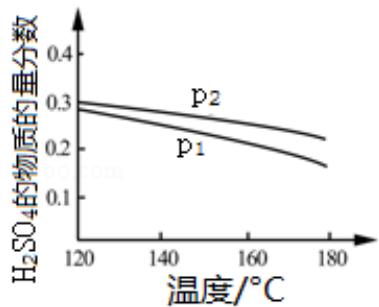
(2)对反应Ⅱ,在某一投料比时,两种压强下, $\mathrm { H } _ { 2 } \mathrm { S O } _ { 4 }$ 在平衡体系中物质的量分数随温度的变化关系如图所示, ${ \sf p } _ { 2 } \_ { \mathrm { ~ \sf ~ \displaystyle ~ } } > \_ { \sf p } _ { 1 }$ (填 $w > " \exists \tilde { \mathfrak { L } } ^ { \mathfrak { a } } < " >$ ,得出该结论的理由是 当温度相同时,增大压强,平衡正向移动,导致硫酸在平衡体系中物质的量分数增大 。
(3)I﹣可以作为水溶液中 $\mathrm { S O } _ { 2 }$ 歧化反应的催化剂,可能的催化过程如下,将 ii补充完整。
i $\mathrm { S O } _ { 2 } { + } 4 \mathrm { I } ^ { - } { + } 4 \mathrm { H } ^ { + } { = } \mathrm { S } \downarrow { + } 2 \mathrm { I } _ { 2 } { + } 2 \mathrm { H } _ { 2 } \mathrm { O }$
ii $\mathrm { I } _ { 2 } + 2 \mathrm { H } _ { 2 } \mathrm { O } + \mathrm { \small ~ \displaystyle { \frac { ~ \cal ~ S } { ~ \cal ~ S } O } } { } _ { 2 } = \mathrm { \small ~ \displaystyle { 4 H ^ { + } ~ \Gamma ~ } ~ } + \mathrm { \small ~ \displaystyle { \frac { ~ \cal ~ S } { ~ \cal ~ S } O } } _ { 4 } ^ { 2 - } + 2 \mathrm { I } ^ { - }$
(4)探究i、ii反应速率与 $\mathrm { S O } _ { 2 }$ 歧化反应速率的关系,实验如下:分别将18 mL$\mathrm { S O } _ { 2 }$ 饱和溶液加入到 2 mL 下列试剂中,密闭放置观察现象,(已知: $\mathrm { I } _ { 2 }$ 易溶解在KI溶液中)
<table><tr><td rowspan=1 colspan=1>序号</td><td rowspan=1 colspan=1>A</td><td rowspan=1 colspan=1>B</td><td rowspan=1 colspan=1>C</td><td rowspan=1 colspan=1>D</td></tr><tr><td rowspan=1 colspan=1>试剂组成</td><td rowspan=1 colspan=1> $0 . 4 \mathrm { m o l } { \cdot } \mathrm { L } ^ { - 1 } \mathrm { K I }$ </td><td rowspan=1 colspan=1> $\mathrm { a \ m o l { \cdot } L ^ { - 1 } K I }$ $0 . 2 \mathrm { \ m o l { \bullet } L ^ { - 1 } \ H _ { 2 } S O _ { 4 } }$ </td><td rowspan=1 colspan=1> $0 . 2 ~ \mathrm { m o l } { \cdot } \mathrm { L } ^ { \cdot 1 }$ $\mathrm { H } _ { 2 } \mathrm { S O } _ { 4 }$ </td><td rowspan=1 colspan=1> $0 . 2 \mathrm { m o l } \bullet \mathrm { L } ^ { - 1 } \mathrm { K I }$ $0 . 0 0 0 2 \mathrm { m o l } \mathrm { I } _ { 2 }$ </td></tr><tr><td rowspan=1 colspan=1>实验现象</td><td rowspan=1 colspan=1>溶液变黄,一段溶时间后出现浑浊</td><td rowspan=1 colspan=1>液变黄,出现浑浊较A快</td><td rowspan=1 colspan=1>无明显现象象</td><td rowspan=1 colspan=1>溶液由棕褐色很快褪色,变成黄色,出现浑浊较A快</td></tr></table>
①B 是 A 的对比实验,则 $\underline { { \mathbf { a } } } \mathbf { - } \underline { { \mathbf { 0 . 4 } } }$
②比较 A、B、C,可得出的结论是 在酸性条件下, $\underline { { \mathbf { S } } } \mathbf { O } _ { 2 }$ 与 I﹣反应速率更快,且 $\underline { { \mathbf { S } } } \mathbf { O } _ { 2 }$ 与稀硫酸不发生反应 。
③实验表明, $\mathrm { S O } _ { 2 }$ 的歧化反应速率 $\mathbf { D } { > } \mathbf { A }$ .结合i,ii反应速率解释原因: 反应i、ii 知, $\underline { { \mathbf { S } } } \mathbf { O } _ { 2 }$ 先和 I﹣反应生成 $\boldsymbol { \mathrm { I } } _ { 2 } , \boldsymbol { \mathrm { ~ I } } _ { 2 }$ 再和 $\underline { { \mathbf { S } } } \mathbf { O } _ { 2 }$ 进一步反应,D 中 KI 溶液溶解
了 $\underline { { \mathrm { I } } } _ { 2 } ,$ ,导致 D中的ii的反应较A快 。
$3 \mathrm { S O _ { 2 } } \mathrm { ( \bf g ) } + 2 \mathrm { H _ { 2 } O } \mathrm { ( \bf g ) } = 2 \mathrm { H _ { 2 } S O _ { 4 } } \mathrm { ( 1 ) } + \mathrm { S \mathrm { ( \bf s ) } } , \Delta \mathrm { H } = - 2 5 4 \mathrm { k J / m o l } ;$