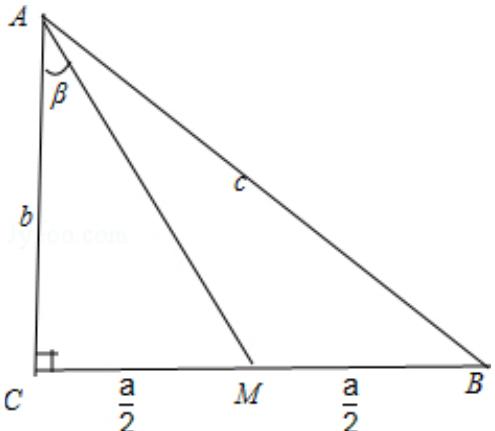
解答: 解:如图
设 $\mathrm { A C = b , A B = c , C M = M B = \frac { \bar { \mathsf { G } } } { 2 } , \mathsf { \Gamma } } \mathsf { \Gamma } \angle \mathrm { M A C = } \mathsf { \mathsf { B } } ,$
在 $\triangle \mathrm { A B M }$ 中,由正弦定理可得 $\frac { \frac { a } { 2 } } { \sin \angle B A M } = \frac { c } { \sin \angle A M B } ,$
代入数据可得 $\frac { \frac { \overline { { \hat { \mathbf { z } } } } } { 2 } } { \frac { 1 } { 3 } } \frac { \mathrm { ~ \overline { { \mathbf { c } } } ~ } } { \mathbf { s i n } \mathcal { L } \mathbf { A } \mathbf { B } } ,$ ,解得 $\sin \angle A M B = \frac { 2 c } { 3 a } ,$
故 $\cos \beta = \cos \mathrm { ~ ( ~ } \frac { \pi } { 2 } - \angle \mathrm { A M C ~ ) } = \sin \angle \mathrm { A M C = \sin ~ ( \pi - \angle A M B ) ~ } = \sin \angle \mathrm { A M B = \frac { 2 c } { 3 \theta } , }$
而在 $\operatorname { R T } \triangle \operatorname { A C M }$ 中, $\cos \beta = \frac { A C } { \sin \pi } = \frac { b } { \sqrt { ( \frac { a } { 2 } ) ^ { 2 } + b ^ { 2 } } } ,$
故可得 $\sqrt { ( \frac { a } { 2 } ) ^ { 2 } + b ^ { 2 } } = \frac { 2 c } { 3 a }$ ,化简可得 $\mathbf { a } ^ { 4 } - 4 \mathbf { a } ^ { 2 } \mathbf { b } ^ { 2 } + 4 \mathbf { b } ^ { 4 } = \mathbf { \left( a ^ { 2 } - 2 b ^ { 2 } \right) } = 0$ 解之可得 $\mathrm { a { = } \sqrt { 2 } b }$ ,再由勾股定理可得 $\mathsf { a } ^ { 2 } { + } \mathsf { b } ^ { 2 } { = } \mathsf { c } ^ { 2 }$ ,联立可得 $\mathsf { c } { = } \sqrt { 3 } \mathsf { b }$ 故在 $\mathrm { R T } \triangle \mathrm { A B C }$ 中, $\sin \angle \mathrm { B A C } = \frac { \mathrm { B C } } { \mathrm { A B } } = \frac { \exists } { \mathrm { ~ c ~ } } \frac { \sqrt { 2 } \mathrm { b } } { \sqrt { 3 } \mathrm { b } } = \frac { \sqrt { 6 } } { 3 } ,$
故答案为: $\frac { \sqrt { 6 } } { 3 }$
点评: 本题考查正弦定理的应用,涉及三角函数的诱导公式以及勾股定理的应用,属中档题