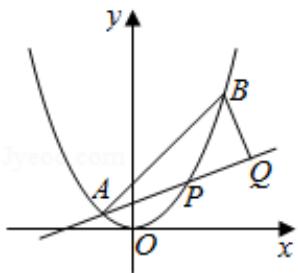
【分析】(Ⅰ)通过点P 在抛物线上可设 ${ \sf P } ^ { \mathrm { ~ \tiny ~ ( ~ x , ~ } \mathrm { ~ \bf { x } } ^ { 2 } \mathrm { ~ ) ~ } }$ ,利用斜率公式结合 $- \frac { 1 } { 2 } < x <$ $\frac { 3 } { 2 }$ 可得结论;
(Ⅱ)通过(I)知 $P ( x , x ^ { 2 } ) \cdot - \frac { 1 } { 2 } < x < \frac { 3 } { 2 }$ ,设直线 AP 的斜率为 k,联立直线AP、BP 方程可知 Q 点坐标,进而可用 k 表示出 $\overrightarrow { \mathrm { P Q } } _ { \mathrm { \Delta } } \overrightarrow { \mathrm { P A } } ,$ ,计算可知 $| \mathsf { P A } | \bullet | \mathsf { P Q } | =$ $\left( 1 + \mathsf { k } \right) \ 3 \ \left( 1 - \mathsf { k } \right)$ ),通过令 ${ \textsf { f } } \ ( \mathbf { \Sigma } \times \mathbf { ) } \ = \ ( \ 1 { + } \times ) \ ^ { \ 3 } \ ( \ 1 \ { - } \ \times ) { \mathbf { , } } \quad { \textsf { - } } \ 1 { < } \times { < } 1$ ,求导结合单调性可得结论
【解答】解:(Ⅰ)由题可知 $P ( x , x ^ { 2 } ) , - \frac { 1 } { 2 } < x < \frac { 3 } { 2 }$
所以 $k _ { A P } = \frac { x ^ { 2 } - \frac { 1 } { 4 } } { x + \frac { 1 } { 2 } } = x - \frac { 1 } { 2 } \in ( - 1 , 1 )$
故直线AP斜率的取值范围是:(﹣1,1);
(Ⅱ)由(I)知 ${ \mathsf p } ( { \mathsf x } , { \mathsf x } ^ { 2 } ) , - \frac { 1 } { 2 } { \mathsf { < x } } { \mathsf { < } } \frac { 3 } { 2 } ;$
所以 $\overrightarrow { P A } = ( - \frac { 1 } { 2 } - x , \frac { 1 } { 4 } - x ^ { 2 } )$
设直线AP的斜率为k,则 ${ A \mathsf { P } } : y = \mathsf { k } \mathsf { x } + \frac { 1 } { 2 } \mathsf { k } ^ { + } \frac { 1 } { 4 } , \mathsf { B } \mathsf { P } : y = - \mathrm { \frac { 1 } { k } } \mathsf { x } ^ { + } \frac { 3 } { 2 \mathsf { k } } + \frac { 9 } { 4 } ,$
联立直线AP、BP 方程可知 $\Omega ~ ( \frac { 3 + 4 \mathrm { k } - \mathrm { k } ^ { 2 } } { 2 \mathrm { k } ^ { 2 } + 2 } , ~ \frac { 9 \mathrm { k } ^ { 2 } + 8 \mathrm { k } + 1 } { 4 \mathrm { k } ^ { 2 } + 4 } )$
故 $\cdot \overrightarrow { \mathrm { P Q } } = \ ( \frac { 1 + \mathrm { k - k } ^ { 2 } - \mathrm { k } ^ { 3 } } { 1 + \mathrm { k } ^ { 2 } } , \ \frac { - \mathrm { k } ^ { 4 } - \mathrm { k } ^ { 3 } + \mathrm { k } ^ { 2 } + \mathrm { k } } { 1 + \mathrm { k } ^ { 2 } } ) ,$
又因为 $\overrightarrow { P A } = ( - 1 - k , - k ^ { 2 } - k )$
$$
- \left| \mathsf { P A } \right| \bullet \left| \mathsf { P Q } \right| = \overrightarrow { \mathrm { P A } } \bullet \overrightarrow { \mathrm { P Q } } = \frac { \left( 1 + \mathbf { k } \right) ^ { 3 } ( \mathbf { k } - \mathbf { 1 } ) } { 1 + \mathbf { k } ^ { 2 } } + \frac { \mathbf { k } ^ { 2 } ( 1 + \mathbf { k } ) ^ { 3 } ( \mathbf { k } - \mathbf { 1 } ) } { 1 + \mathbf { k } ^ { 2 } } = \ ( \mathbf { 1 } + \mathbf { k } ) \ ^ { 3 } \ ( \mathbf { k } - \mathbf { 1 } ) ,
$$
所以 $\left| \mathsf { P A } \right| \bullet \left| \mathsf { P Q } \right| = \mathrm { \Omega } ( 1 + \mathsf { k } ) \ 3 \ \mathrm { \Omega } ( 1 - \mathsf { k } )$ 9
令 ${ \textsf { f } } \ ( \mathbf { x } ) \ = \ ( \ 1 { + } \mathbf { x } ) ^ { \ 3 } \ ( \ 1 \ { - } \ \mathbf { x } ) { \mathrm { , } } \quad { \mathfrak { - } } \ 1 { < } \mathbf { x } { < } 1$
则 $f ^ { \prime } ( \mathbf { x } ) = ( 1 + \mathbf { x } ) ^ { \textit { 2 } } ( 2 - 4 \mathbf { x } ) = - 2 ( 1 + \mathbf { x } ) ^ { \textit { 2 } } ( 2 \mathbf { x } - 1 )$
由于当 $- \left. 1 < x < - \frac { 1 } { 2 } \right.$ 时 $\mathsf { f } ^ { \prime } \left( \mathsf { x } \right) > 0$ ,当 $\frac { 1 } { 2 } < x < 1$ 时 $\mathsf { f } ^ { \prime } \left( \mathsf { x } \right) < 0$
故 f $( x ) \ \mathsf { \Pi } _ { \mathsf { m a x } } = \mathsf { f } \ ( \frac { 1 } { 2 } ) \ = \frac { 2 7 } { 1 6 }$ ,即 $| \mathsf { P A } | \bullet | \mathsf { P Q } |$ 的最大值为 $\frac { 2 7 } { 1 6 }$ .
【点评】本题考查圆锥曲线的最值问题,考查运算求解能力,考查函数思想,注意解题方法的积累,属于中档题