19.(12分)如图,四棱锥 $P-A B C D$ 中,底面 $A B C D$ 为菱形,$P A \perp$ 底面 $A B C D$ , $\mathrm{AC}=2 \sqrt{2}, \mathrm{PA}=2, \mathrm{E}$ 是 PC 上的一点, $\mathrm{PE}=2 \mathrm{EC}$ .
(I)证明: $\mathrm{PC} \mathrm{\perp}$ 平面 BED ;
(II)设二面角 $\mathrm{A}-\mathrm{PB}-\mathrm{C}$ 为 $90^{\circ}$ ,求 PD 与平面 PBC 所成角的大小。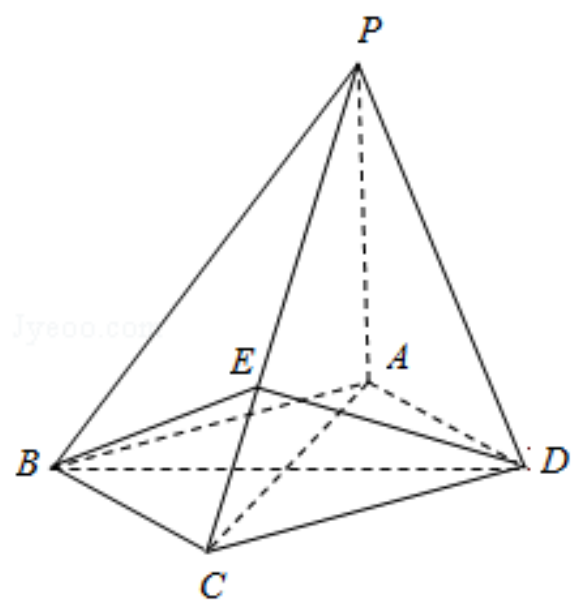
(12分)如图,四棱锥 P-A B C D 中,底面 A…——2012 高考数学第 19 题答案解析
2012_大纲版 (2012·文)
完整解析 · 逐步详解
【考点】LW:直线与平面垂直; MI :直线与平面所成的角; MM :向量语言表述线面的垂直、平行关系.
【专题】11:计算题.
【分析】(I)先由已知建立空间直角坐标系,设D( $\sqrt{2}$ ,b,0),从而写出相关点和相关向量的坐标,利用向量垂直的充要条件,证明 $P C \perp B E, P C \perp D E$ ,从而利用线面垂直的判定定理证明结论即可;
(II)先求平面 PAB 的法向量,再求平面 PBC 的法向量,利用两平面垂直的性质 ,即可求得 b 的值,最后利用空间向量夹角公式即可求得线面角的正弦值,进而求得线面角
【解答】解:(1)以 A 为坐标原点,建立如图空间直角坐标系 $\mathrm{A}-\mathrm{xyz}$ ,设 $\mathrm{D}(\sqrt{2}, \mathrm{~b}, 0)$ ,则 $\mathrm{C}(2 \sqrt{2}, 0,0), \mathrm{P}(0,0,2), \mathrm{E}\left(\frac{4 \sqrt{2}}{3}, 0, \frac{2}{3}\right)$ , $B(\sqrt{2},-b, 0)$
$\therefore \overrightarrow{\mathrm{PC}}=(2 \sqrt{2}, 0,-2), \overrightarrow{\mathrm{BE}}=\left(\frac{\sqrt{2}}{3}, \mathrm{~b}, \frac{2}{3}\right), \overrightarrow{\mathrm{DE}}=\left(\frac{\sqrt{2}}{3},-\mathrm{b}, \frac{2}{3}\right)$
$\therefore \overrightarrow{\mathrm{PC}} \cdot \overrightarrow{\mathrm{BE}}=\frac{4}{3}-\frac{4}{3}=0, \quad \overrightarrow{\mathrm{PC}} \cdot \overrightarrow{\mathrm{DE}}=0$
$\therefore P C \perp B E, P C \perp D E, B E \cap D E=E$
$\therefore \mathrm{PC} \mathrm{\perp}$ 平面 BED
(ii) $\overrightarrow{\mathrm{AP}}=(0,0,2), \overrightarrow{\mathrm{AB}}=(\sqrt{2},-\mathrm{b}, 0)$
设平面 $P A B$ 的法向量为 $\overrightarrow{\mathrm{r}}=(x, y, z)$ ,则 $\left\{\begin{array}{l}\overrightarrow{\mathrm{m}} \cdot \overrightarrow{\mathrm{AP}}=2 z=0 \\ \overrightarrow{\mathrm{~m}} \cdot \overrightarrow{\mathrm{AB}}=\sqrt{2} x-b y=0\end{array}\right.$
取 $\vec{\Pi}=(b, \sqrt{2}, 0)$
设平面 $P B C$ 的法向量为 $\vec{n}=(p, q, r)$ ,则 $\left\{\begin{array}{l}\vec{n} \cdot \overrightarrow{P C}=2 \sqrt{2} p-2 r=0 \\ \vec{n} \cdot \overrightarrow{B E}=\frac{\sqrt{2}}{3} p+b q+\frac{2}{3} r=0\end{array}\right.$
取 $\overrightarrow{\mathrm{n}}=\left(1,-\frac{\sqrt{2}}{\mathrm{~b}}, \sqrt{2}\right)$
$\because$ 平面 $\mathrm{PAB} \perp$ 平面 $\mathrm{PBC}, \quad \therefore \vec{\pi} \cdot \overrightarrow{\mathrm{n}}=\mathrm{b}-\frac{2}{\mathrm{~b}}=0$ .故 $\mathrm{b}=\sqrt{2}$
$\therefore \overrightarrow{\mathrm{n}}=(1,-1, \sqrt{2}), \overrightarrow{\mathrm{DP}}=(-\sqrt{2},-\sqrt{2}, 2)$
$\therefore \cos <\overrightarrow{\mathrm{DP}}, \overrightarrow{\mathrm{n}}>=\frac{\overrightarrow{\mathrm{n}} \cdot \overrightarrow{\mathrm{DP}}}{|\overrightarrow{\mathrm{n}}| \cdot|\overrightarrow{\mathrm{DP}}|}=\frac{1}{2}$
设 PD 与平面 PBC 所成角为 $\theta, \theta \in\left[0, \frac{\pi}{2}\right]$ ,则 $\sin \theta=\frac{1}{2}$
$\therefore \theta=30^{\circ}$
$\therefore \mathrm{PD}$ 与平面 PBC 所成角的大小为 $30^{\circ}$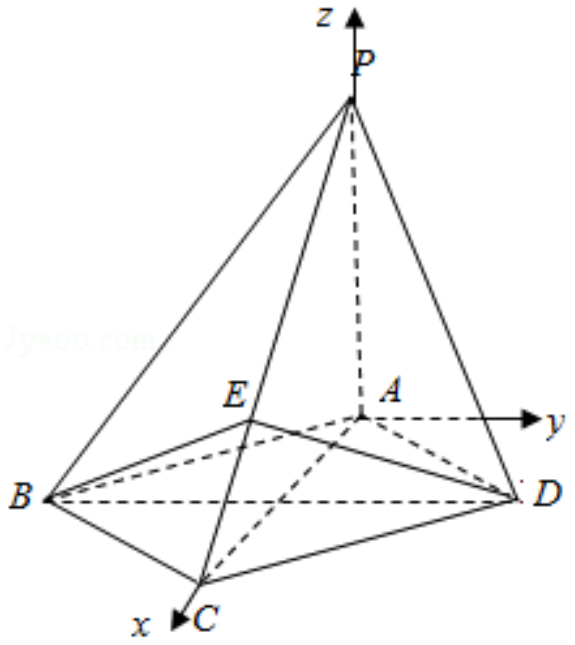
【点评】本题主要考查了利用空间直角坐标系和空间向量解决立体几何问题的一般方法,线面垂直的判定定理,空间线面角的求法,有一定的运算量,属中档题
✅ 来源:2012年 · 全国 · 2012_大纲版 (2012·文) · 第 19 题 · 本题已通过人工审核与系统自动校验