【考点】D5:弱电解质在水溶液中的电离平衡
【专题】51G:电离平衡与溶液的pH专题
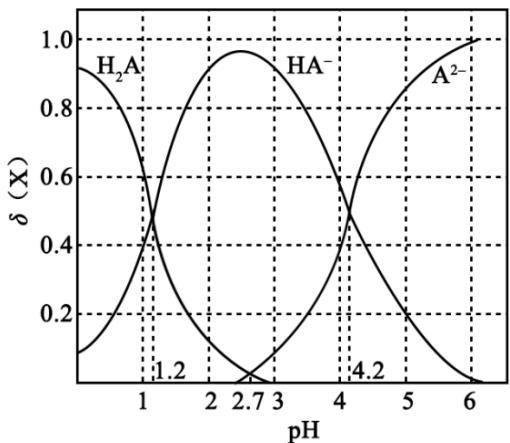
【分析】由图象可知,pH=1.2 时, ${ \bf c } \mathrm { ~ ( ~ H _ { 2 } A ) ~ } = { \bf c } \mathrm { ~ ( ~ H A ^ { - } ~ ) ~ }$ ,PH=2.7 时, $\begin{array} { r l } { \mathbf { c } } & { { } ( \mathrm { H } _ { 2 } \mathbf { A } ) } \end{array}$ $\scriptstyle \mathbf { \alpha } = \mathbf { c } ( \mathbf { A } ^ { 2 \mathrm { ~ - ~ } } )$ ,pH=4.2 时, $\mathbf { c } \ \left( \mathbf { H } \mathbf { A } ^ { - } \right) \mathbf { \Lambda } = \mathbf { c } \ \left( \mathbf { A } ^ { 2 \cdot } \mathbf { \Lambda } \right)$ ,随着pH的增大, $\begin{array} { r l } { \mathbf { c } } & { { } ( \mathrm { H } _ { 2 } \mathbf { A } ) } \end{array}$ 逐渐减小,c(HA﹣)先增大后减小, $\mathrm { ~ c ~ } \left( \mathrm { A } ^ { 2 \mathrm { ~ - ~ } } \right)$ 逐渐增大,结合电离平衡常数以及题给数据计算,可根据纵坐标比较浓度大小,以此解答该题。
【解答】解:A.由图象可知 $\mathrm { p H } { = } 1 . 2$ 时, $\mathrm { H } _ { 2 } \mathrm { A }$ 与HA﹣的曲线相交,则 $\begin{array} { r l } { \mathbf { c } } & { { } ( \mathrm { H } _ { 2 } \mathbf { A } ) } \end{array}$ $\Rightarrow \mathrm { ( H A ^ { \cdot } ) }$ ,故A正确;
B.pH=4.2 时, $\mathrm { ~ c ~ } \left( \mathrm { ~ H ^ { + } ~ } \right) \mathrm { ~ = } 1 0 ^ { - 4 . 2 } \mathrm { m o l / L }$ ,c(HA﹣ )=c(A<sup>2</sup>﹣ ), $\begin{array} { r l } { \mathrm { K } _ { 2 } } & { { } ( \ \mathrm { H } _ { 2 } \mathrm { A } ) } \end{array}$ $= \frac { \mathsf { c } ( \mathsf { A } ^ { 2 - } ) \mathsf { c } ( \mathsf { H } ^ { + } ) } { \mathsf { c } ( \mathsf { H A } ^ { - } ) } { } = 1 0 ^ { - 4 . 2 }$ ,则 $\mathrm { l g } \left[ \mathrm { K } _ { 2 } ~ \left( \mathrm { H } _ { 2 } \mathrm { A } \right) ~ \right] = - ~ 4 . 2$ ,故B正确;
C.由图象可知,PH=2.7 时, $\mathbf { c } \ \left( \mathbf { H } _ { 2 } \mathbf { A } \right) = \mathbf { c } \ \left( \mathbf { A } ^ { 2 \cdot } \mathbf { \Lambda } \right)$ ,由纵坐标数据可知 $\mathrm { { \textbf { c } } \left( H A ^ { - } \right) > }$ ${ \bf c } \mathrm { ~ ( ~ H _ { 2 } A ) ~ } = { \bf c } \mathrm { ~ ( ~ A ^ { 2 \cdot } ~ ) ~ }$ ,故 C 正确;
D.pH=4.2 时, $\mathbf { c } \ \left( \mathbf { H } \mathbf { A } ^ { - } \right) \mathbf { \Lambda } = \mathbf { c } \ \left( \mathbf { A } ^ { 2 \cdot } \mathbf { \Lambda } \right)$ ,但此时 $\mathrm { ~ c ~ } \left( { \mathrm { H } } _ { 2 } \mathbf { A } \right) \approx 0$ ,如体积不变,则 c$( \mathrm { H } \mathrm { A } ^ { \cdot } \ ) \ = \mathrm { c } ( \mathrm { A } ^ { 2 \cdot } \ ) \ = 0 . 0 5 \mathrm { m o l } \bullet \mathrm { L }$ ﹣<sup>1</sup>, $\mathrm { ~ c ~ } \left( \mathrm { H ^ { + } } \right) = 1 0 ^ { - 4 . 2 } \mathrm { m o l / L }$ ,如体积变化,则不
能确定c(HA﹣)、 $\mathrm { ~ c ~ } \left( \mathrm { A } ^ { 2 \mathrm { ~ - ~ } } \right)$ 与c(H+)浓度大小关系,故D错误。
故选:D。
【点评】本题考查弱电解质的电离,为高频考点,侧重考查学生的分析能力和计算能力,本题注意把握弱电解质的电离特点以及题给图象的曲线变化,难度中等。