19.(12分)已知 $\left\{x_{n}\right\}$ 是各项均为正数的等比数列,且 $x_{1}+x_{2}=3, x_{3}-x_{2}=2$ .
(I)求数列 $\left\{x_{n}\right\}$ 的通项公式;
(II)如图,在平面直角坐标系 xOy 中,依次连接点 $\mathrm{P}_{1}\left(\mathrm{x}_{1}, 1\right), \mathrm{P}_{2}\left(\mathrm{x}_{2}, 2\right) \ldots P_{n+1}\left(x_{n+1}, n+1\right)$ 得到折线 $P_{1}$
$P_{2} \ldots P_{n+1}$ ,求由该折线与直线 $y=0, x=x_{1}, x=x_{n+1}$ 所围成的区域的面积 $T_{n}$ .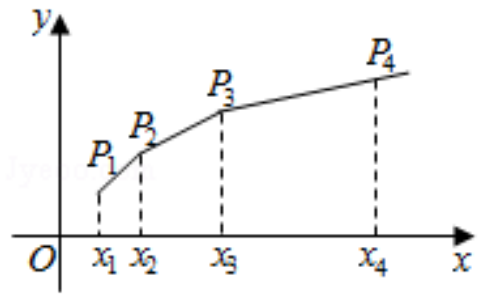
(12分)已知 x_ n 是各项均为正数的等比数列,且 x…——2017 高考数学第 19 题答案解析
2017_退役省自主命题 (2017·理)
完整解析 · 逐步详解
【解答】
(12分)(2017 • 山东)已知 $\left\{x_{n}\right\}$ 是各项均为正数的等比数列,且 $x_{1}+x_{2}=3$ , $x_{3}-x_{2}=2$.
(I)求数列 $\left\{x_{n}\right\}$ 的通项公式;
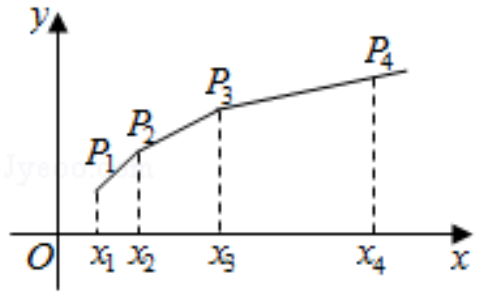
(II)如图,在平面直角坐标系 xOy 中,依次连接点 $\mathrm{P}_{1}\left(\mathrm{x}_{1}, 1\right), \mathrm{P}_{2}\left(\mathrm{x}_{2}, 2\right) \ldots P_{n+1}\left(x_{n+1}, n+1\right)$ 得到折线 $P_{1}$
$P_{2} \ldots P_{n+1}$ ,求由该折线与直线 $y=0, x=x_{1}, x=x_{n+1}$ 所围成的区域的面积 $T_{n}$ .
【解答】解:(I)设数列 $\left\{x_{n}\right\}$ 的公比为 $q$ ,则 $q>0$ ,
由题意得 $\left\{\begin{array}{l}x_{1}+x_{1} q=3 \\ x_{1} q^{2}-x_{1} q=2\end{array}\right.$ ,
两式相比得:$\frac{1+q}{q^{2}-q}=\frac{3}{2}$ ,解得 $q=2$ 或 $q=-\frac{1}{3}$(舍),
$\therefore \mathrm{x}_{1}=1$ ,
$\therefore \mathrm{x}_{\mathrm{n}}=2^{\mathrm{n}-1}$ 。
(II)过 $\mathrm{P}_{1}, \mathrm{P}_{2}, \mathrm{P}_{3}, \ldots, \mathrm{P}_{\mathrm{n}}$ 向 x 轴作垂线,垂足为 $\mathrm{Q}_{1}, \mathrm{Q}_{2}, \mathrm{Q}_{3}, \ldots, \mathrm{Q}_{\mathrm{n}}$ ,
即梯形 $P_{n} P_{n+1} Q_{n+1} Q_{n}$ 的面积为 $b_{n}$ ,
则 $\mathrm{b}_{\mathrm{n}}=\frac{\mathrm{n}+\mathrm{n}+1}{2} \times 2^{\mathrm{n}-1}=(2 \mathrm{n}+1) \times 2^{\mathrm{n}-2}$ ,
$\therefore \mathrm{T}_{\mathrm{n}}=3 \times 2^{-1}+5 \times 2^{0}+7 \times 2^{1}+\ldots+(2 \mathrm{n}+1) \times 2^{\mathrm{n}-2}$ ,①
$\therefore 2 \mathrm{~T}_{\mathrm{n}}=3 \times 2^{0}+5 \times 2^{1}+7 \times 2^{2}+\ldots+(2 \mathrm{n}+1) \times 2^{\mathrm{n}-1}$ ,②
①-②得:$-T_{n}=\frac{3}{2}+\left(2+2^{2}+\ldots+2^{n-1}\right)-(2 n+1) \times 2^{n-1}$
$=\frac{3}{2}+\frac{2\left(1-2^{n-1}\right)}{1-2}-(2 n+1) \times 2^{n-1}=-\frac{1}{2}+(1-2 n) \times 2^{n-1}$ .
$\therefore \mathrm{T}_{\mathrm{n}}=\frac{(2 \mathrm{n}-1) \times 2^{\mathrm{n}}+1}{2}$ .
✅ 来源:2017年 · 全国 · 2017_退役省自主命题 (2017·理) · 第 19 题 · 本题已通过人工审核与系统自动校验
再练一道 · 同类压轴题
2023 区分题 · 2023_全国甲卷 (2023·理)
已知正项等比数列 a_ n 中, a_ 1 =1, S_ n 为 a_ n 前 n 项和, S…
2020 区分题 · 2020_新课标 II 卷 (2020)
已知公比大于 1 的等比数列 a_ n 满足 a_ 2 +a_ 4 =20, a_ 3 =8…
2018 区分题 · 2018_新课标 III 卷 (201…
(12分)等比数列 a_ n 中, a_ 1 =1, a_ 5 =4 a_ 3 . (1)求…