【答案】①$\left\{\begin{array}{l}x=2+\cos \alpha \\ y=1+\sin \alpha\end{array},(\alpha\right.$ 为参数);
②$\rho \sin \left(\theta+\frac{5 \pi}{6}\right)=2-\frac{\sqrt{3}}{2}$ 和 $\rho \sin \left(\theta+\frac{\pi}{6}\right)=2+\frac{\sqrt{3}}{2}$ .
【解析】
【分析】(1)直接利用圆心及半径可得的圆的参数方程;
(2)先求得过(4,1)的圆的切线方程,再利用极坐标与直角坐标互化公式化简即可.
【详解】①由题意,$\odot C$ 的普通方程为 $(x-2)^{2}+(y-1)^{2}=1$ ,
所以 $\odot C$ 的参数方程为 $\left\{\begin{array}{l}x=2+\cos \alpha \\ y=1+\sin \alpha\end{array},(\alpha\right.$ 为参数)
**方法一**:直角坐标系方法
①当直线的斜率不存在时,直线方程为 $x=4$ ,此时圆心到直线的距离为 $2>r$ ,故舍去.
②当切线斜率存在时,设其方程为 $y=k(x-4)+1$ ,即 $k x-y-4 k+1=0$ .
故 $\frac{|2 k-1-4 k+1|}{\sqrt{1+k^{2}}}=1$ ,即 $|2 k|=\sqrt{1+k^{2}}, 4 k^{2}=1+k^{2}$ ,解得 $k= \pm \frac{\sqrt{3}}{3}$ .
所以切线方程为 $y=\frac{\sqrt{3}}{3}(x-4)+1$ 或 $y=-\frac{\sqrt{3}}{3}(x-4)+1$ .
两条切线的极坐标方程分别为 $\rho \sin \theta=\frac{\sqrt{3}}{3} \rho \cos \theta-\frac{4 \sqrt{3}}{3}+1$ 和 $\rho \sin \theta=-\frac{\sqrt{3}}{3} \rho \cos \theta+\frac{4 \sqrt{3}}{3}+1$ .
即 $\rho \sin \left(\theta+\frac{5 \pi}{6}\right)=2-\frac{\sqrt{3}}{2}$ 和 $\rho \sin \left(\theta+\frac{\pi}{6}\right)=2+\frac{\sqrt{3}}{2}$ .
**方法二**:【最优解】:定义求斜率法
如图所示,过点 $F$ 作 $\odot C$ 的两条切线,切点分别为 $A, B$ .
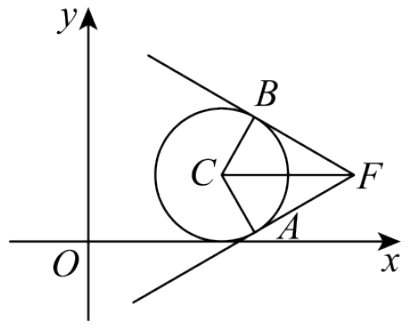
在 $\triangle A C F$ 中, $\tan \angle A F C=\frac{A C}{A F}=\frac{\sqrt{3}}{3}$ ,又 $C F / / x$ 轴,所以两条切线 $F A, F B$ 的斜率分别 $\frac{\sqrt{3}}{3}$ 和
$-\frac{\sqrt{3}}{3}$.
故切线的方程为 $y=\frac{\sqrt{3}}{3}(x-4)+1, y=-\frac{\sqrt{3}}{3} \cdot(x-4)+1$ ,这两条切线的极坐标方程为
$\rho \sin \theta=\frac{\sqrt{3}}{3} \rho \cos \theta-\frac{4}{3} \sqrt{3}+1$ 和 $\rho \sin \theta=-\frac{\sqrt{3}}{3} \rho \cos \theta+\frac{4}{3} \sqrt{3}+1$ .
即 $\rho \sin \left(\theta+\frac{5 \pi}{6}\right)=2-\frac{\sqrt{3}}{2}$ 和 $\rho \sin \left(\theta+\frac{\pi}{6}\right)=2+\frac{\sqrt{3}}{2}$ .
【整体点评】(2)
**方法一**:直角坐标系中直线与圆相切的条件求得切线方程,再转化为极坐标方程,
**方法二**:直接根据倾斜角求得切线的斜率,得到切线的直角坐标方程,然后转化为极坐标方程,在本题中巧妙的利用已知圆和点的特殊性求解,计算尤其简洁,为最优解.