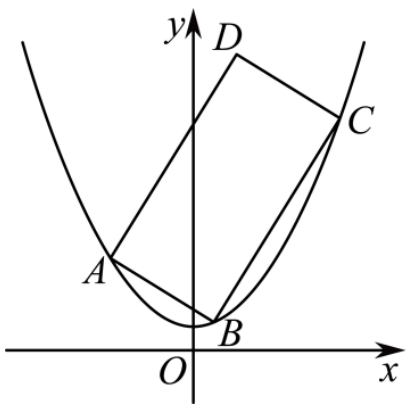
22.在直角坐标系 $x O y$ 中,点 $P$ 到 $x$ 轴的距离等于点 $P$ 到点 $\left(0, \frac{1}{2}\right)$ 的距离,记动点 $P$ 的轨迹为 $W$ .
(1)求 $W$ 的方程;
(2)已知矩形 $A B C D$ 有三个顶点在 $W$ 上,证明:矩形 $A B C D$ 的周长大于 $3 \sqrt{3}$ .
参考答案(1) $y=x^{2}+\frac{1}{4}$; (2) 见解析
2023_新课标 I 卷 (2023)
22.在直角坐标系 $x O y$ 中,点 $P$ 到 $x$ 轴的距离等于点 $P$ 到点 $\left(0, \frac{1}{2}\right)$ 的距离,记动点 $P$ 的轨迹为 $W$ .
(1)求 $W$ 的方程;
(2)已知矩形 $A B C D$ 有三个顶点在 $W$ 上,证明:矩形 $A B C D$ 的周长大于 $3 \sqrt{3}$ .
【答案】①$y=x^{2}+\frac{1}{4}$
(2)见解析
## 【解析】
【分析】①设 $P(x, y)$ ,根据题意列出方程 $x^{2}+\left(y-\frac{1}{2}\right)^{2}=y^{2}$ ,化简即可;
(2)法一:设矩形的三个顶点 $A\left(a, a^{2}+\frac{1}{4}\right), B\left(b, b^{2}+\frac{1}{4}\right), C\left(c, c^{2}+\frac{1}{4}\right)$ ,且 $a
法二:设直线 $A B$ 的方程为 $y=k(x-a)+a^{2}+\frac{1}{4}$ ,将其与抛物线方程联立,再利用弦长公式和放缩法得 $|A B|+|A D| \geq \sqrt{\frac{\left(1+k^{2}\right)^{3}}{k^{2}}}$ ,利用换元法和求导即可求出周长最值,再排除边界值即可。
法三:利用平移坐标系法,再设点,利用三角换元再对角度分类讨论,结合基本不等式即可证明。
【小问 1 详解】
设 $P(x, y)$ ,则 $|y|=\sqrt{x^{2}+\left(y-\frac{1}{2}\right)^{2}}$ ,两边同平方化简得 $y=x^{2}+\frac{1}{4}$ ,
故 $W: y=x^{2}+\frac{1}{4}$ .
## 【小问 2 详解】
法一:设矩形的三个顶点 $A\left(a, a^{2}+\frac{1}{4}\right), B\left(b, b^{2}+\frac{1}{4}\right), C\left(c, c^{2}+\frac{1}{4}\right)$ 在 $W$ 上,且 $a 则 $k_{A B} \cdot k_{B C}=-1, a+b 则令 $f(x)=\left(x+\frac{1}{x}\right)^{2}\left(1+x^{2}\right), x>0, f^{\prime}(x)=2\left(x+\frac{1}{x}\right)^{2}\left(2 x-\frac{1}{x}\right)$ , 得证. 法二:不妨设 $A, B, D$ 在 $W$ 上,且 $B A \perp D A$ , 依题意可设 $A\left(a, a^{2}+\frac{1}{4}\right)$ ,易知直线 $B A, D A$ 的斜率均存在且不为 0 , 则 $f(m)_{\text {min }}=f\left(\frac{1}{2}\right)=\frac{27}{4}$ , $>\frac{\sin \theta(\cos \theta-\sin \theta)(\sin \theta \cos \theta)}{\sin ^{2} \theta \cos ^{3} \theta}+\frac{\sin ^{3} \theta+\cos ^{3} \theta}{\sin ^{2} \theta \cos ^{2} \theta}=\frac{1}{\cos \theta}+\frac{\cos \theta}{\sin ^{2} \theta}$ 【点睛】关键点睛:本题的第二个的关键是通过放缩得 $\frac{1}{2} C=|A B|+|B C| \geq\left(n+\frac{1}{n}\right) \sqrt{1+n^{2}}$ ,同时为了简便运算,对右边的式子平方后再设新函数求导,最后再排除边界值即可.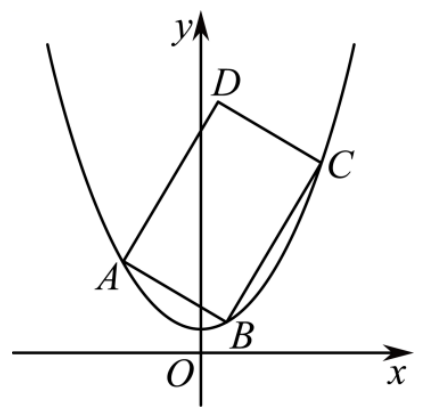
设矩形周长为 $C$ ,由对称性不妨设 $|m| \geq|n|, k_{B C}-k_{A B}=c-a=n-m=n+\frac{1}{n}$ ,
则 $\frac{1}{2} C=|A B|+|B C|=(b-a) \sqrt{1+m^{2}}+(c-b) \sqrt{1+n^{2}} \geq(c-a) \sqrt{1+n^{2}}=\left(n+\frac{1}{n}\right) \sqrt{1+n^{2}} . n>0$ ,易知 $\left(n+\frac{1}{n}\right) \sqrt{1+n^{2}}>0$
令 $f^{\prime}(x)=0$ ,解得 $x=\frac{\sqrt{2}}{2}$ ,
当 $x \in\left(0, \frac{\sqrt{2}}{2}\right)$ 时,$f^{\prime}(x)<0$ ,此时 $f(x)$ 单调递减,
当 $x \in\left(\frac{\sqrt{2}}{2},+\infty\right), f^{\prime}(x)>0$ ,此时 $f(x)$ 单调递增,
则 $f(x)_{\text {min }}=f\left(\frac{\sqrt{2}}{2}\right)=\frac{27}{4}$ ,
故 $\frac{1}{2} C \geq \sqrt{\frac{27}{4}}=\frac{3 \sqrt{3}}{2}$ ,即 $C \geq 3 \sqrt{3}$ .
当 $C=3 \sqrt{3}$ 时,$n=\frac{\sqrt{2}}{2}, m=-\sqrt{2}$ ,且 $(b-a) \sqrt{1+m^{2}}=(b-a) \sqrt{1+n^{2}}$ ,即 $m=n$ 时等号成立,矛盾,故 $C>3 \sqrt{3}$ ,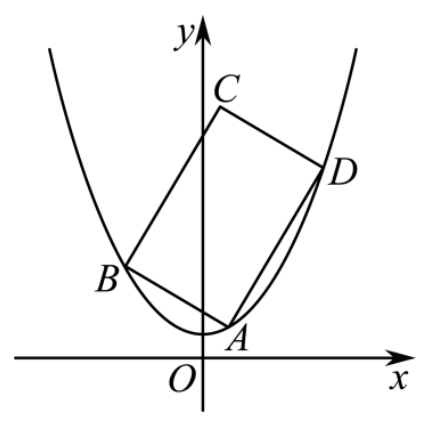
则设 $B A, D A$ 的斜率分别为 $k$ 和 $-\frac{1}{k}$ ,由对称性,不妨设 $|k| \leq 1$ ,
直线 $A B$ 的方程为 $y=k(x-a)+a^{2}+\frac{1}{4}$ ,
则联立 $\left\{\begin{array}{l}y=x^{2}+\frac{1}{4} \\ y=k(x-a)+a^{2}+\frac{1}{4}\end{array}\right.$ 得 $x^{2}-k x+k a-a^{2}=0$ ,
$\Delta=k^{2}-4\left(k a-a^{2}\right)=(k-2 a)^{2}>0$ ,则 $k \neq 2 a$
则 $|A B|=\sqrt{1+k^{2}}|k-2 a|$ ,
同理 $|A D|=\sqrt{1+\frac{1}{k^{2}}}\left|\frac{1}{k}+2 a\right|$ ,
$\therefore|A B|+|A D|=\sqrt{1+k^{2}}|k-2 a|+\sqrt{1+\frac{1}{k^{2}}}\left|\frac{1}{k}+2 a\right|$
$\geq \sqrt{1+k^{2}}\left(|k-2 a|+\left|\frac{1}{k}+2 a\right|\right) \geq \sqrt{1+k^{2}}\left|k+\frac{1}{k}\right|=\sqrt{\frac{\left(1+k^{2}\right)^{3}}{k^{2}}}$
令 $k^{2}=m$ ,则 $m \in(0,1]$ ,设 $f(m)=\frac{(m+1)^{3}}{m}=m^{2}+3 m+\frac{1}{m}+3$ ,
则 $f^{\prime}(m)=2 m+3-\frac{1}{m^{2}}=\frac{(2 m-1)(m+1)^{2}}{m^{2}}$ ,令 $f^{\prime}(m)=0$ ,解得 $m=\frac{1}{2}$ ,
当 $m \in\left(0, \frac{1}{2}\right)$ 时,$f^{\prime}(m)<0$ ,此时 $f(m)$ 单调递减,
当 $m \in\left(\frac{1}{2},+\infty\right), f^{\prime}(m)>0$ ,此时 $f(m)$ 单调递增,
$\therefore|A B|+|A D| \geq \frac{3 \sqrt{3}}{2}$ ,
但 $\sqrt{1+k^{2}}|k-2 a|+\sqrt{1+\frac{1}{k^{2}}}\left|\frac{1}{k}+2 a\right| \geq \sqrt{1+k^{2}}\left(|k-2 a|+\left|\frac{1}{k}+2 a\right|\right)$ ,此处取等条件为 $k=1$ ,与最终取等
时 $k=\frac{\sqrt{2}}{2}$ 不一致,故 $|A B|+|A D|>\frac{3 \sqrt{3}}{2}$ .
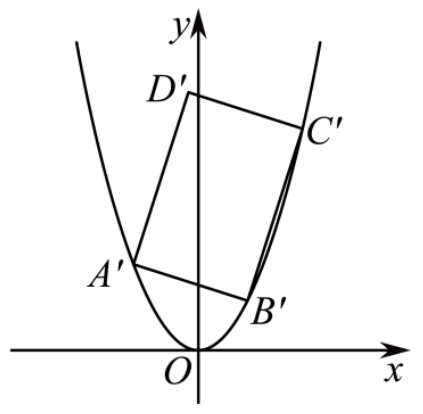
法三:为了计算方便,我们将抛物线向下移动 $\frac{1}{4}$ 个单位得抛物线 $W^{\prime}: y=x^{2}$ ,
矩形 $A B C D$ 变换为矩形 $A^{\prime} B^{\prime} C^{\prime} D^{\prime}$ ,则问题等价于矩形 $A^{\prime} B^{\prime} C^{\prime} D^{\prime}$ 的周长大于 $3 \sqrt{3}$ .
设 $B^{\prime}\left(t_{0}, t_{0}^{2}\right), A^{\prime}\left(t_{1}, t_{1}^{2}\right), C^{\prime}\left(t_{2}, t_{2}^{2}\right)$ ,根据对称性不妨设 $t_{0} \geq 0$ .
则 $k_{A^{\prime} B^{\prime}}=t_{1}+t_{0}, k_{B^{\prime} C^{\prime}}=t_{2}+t_{0}$ ,由于 $A^{\prime} B^{\prime} \perp B^{\prime} C^{\prime}$ ,则 $\left(t_{1}+t_{0}\right)\left(t_{2}+t_{0}\right)=-1$ .
由于 $\left|A^{\prime} B^{\prime}\right|=\sqrt{1+\left(t_{1}+t_{0}\right)^{2}}\left|t_{1}-t_{0}\right|,\left|B^{\prime} C^{\prime}\right|=\sqrt{1+\left(t_{2}+t_{0}\right)^{2}}\left|t_{2}-t_{0}\right|$ ,且 $t_{0}$ 介于 $t_{1}, t_{2}$ 之间,
则 $\left|A^{\prime} B^{\prime}\right|+\left|B^{\prime} C^{\prime}\right|=\sqrt{1+\left(t_{1}+t_{0}\right)^{2}}\left|t_{1}-t_{0}\right|+\sqrt{1+\left(t_{2}+t_{0}\right)^{2}}\left|t_{2}-t_{0}\right|$ 。令 $t_{2}+t_{0}=\tan \theta$ ,
$t_{1}+t_{0}=-\cot \theta, \theta \in\left(0, \frac{\pi}{2}\right)$ ,则 $t_{2}=\tan \theta-t_{0}, t_{1}=-\cot \theta-t_{0}$ ,从而
$\left|A^{\prime} B^{\prime}\right|+\left|B^{\prime} C^{\prime}\right|=\sqrt{1+\cot ^{2} \theta}\left(2 t_{0}+\cot \theta\right)+\sqrt{1+\tan ^{2} \theta}\left(\tan \theta-2 t_{0}\right)$
故 $\left|A^{\prime} B^{\prime}\right|+\left|B^{\prime} C^{\prime}\right|=2 t_{0}\left(\frac{1}{\sin \theta}-\frac{1}{\cos \theta}\right)+\frac{\sin \theta}{\cos ^{2} \theta}+\frac{\cos \theta}{\sin ^{2} \theta}=\frac{2 t_{0}(\cos \theta-\sin \theta)}{\sin \theta \cos \theta}+\frac{\sin ^{3} \theta+\cos ^{3} \theta}{\sin ^{2} \theta \cos ^{2} \theta}$
(1)当 $\theta \in\left(0, \frac{\pi}{4}\right]$ 时,
$\left|A^{\prime} B^{\prime}\right|+\left|B^{\prime} C^{\prime}\right| \geq \frac{\sin ^{3} \theta+\cos ^{3} \theta}{\sin ^{2} \theta \cos ^{2} \theta}=\frac{\sin \theta}{\cos ^{2} \theta}+\frac{\cos \theta}{\sin ^{2} \theta} \geq 2 \sqrt{\frac{1}{\sin \theta \cos \theta}}=2 \sqrt{\frac{2}{\sin 2 \theta}} \geq 2 \sqrt{2}$
(2)当 $\theta \in\left(\frac{\pi}{4}, \frac{\pi}{2}\right)$ 时,由于 $t_{1}
$=\sqrt{\frac{2}{\sin ^{2} \theta \sin ^{2} \theta \cdot 2 \cos ^{2} \theta}}=\sqrt{\frac{2}{\left(1-\cos ^{2} \theta\right)\left(1-\cos ^{2} \theta\right) \cdot 2 \cos ^{2} \theta}}$
$\geq \sqrt{\frac{2}{\left(\frac{\left(1-\cos ^{2} \theta\right)+\left(1-\cos ^{2} \theta\right)+2 \cos ^{2} \theta}{3}\right)^{3}}} \geq \sqrt{\frac{2}{\left(\frac{2}{3}\right)^{3}}}=\frac{3 \sqrt{3}}{2}$,
当且仅当 $\cos \theta=\frac{\sqrt{3}}{3}$ 时等号成立,故 $\left|A^{\prime} B^{\prime}\right|+\left|B^{\prime} C^{\prime}\right|>\frac{3 \sqrt{3}}{2}$ ,故矩形周长大于 $3 \sqrt{2}$ .